Why is my water kefir not fizzy?
Your water kefir tastes fine but stays flat as water? In almost every case, it's the second ferment that's missing or didn't get what it needed. The bubbles don't form in the open jar (F1): they build in a sealed bottle (F2), when the yeasts produce CO₂ with nowhere to escape.
Here are the six causes, from most to least common.
1. You skip the F2 (the #1 cause)
The F1, open under a cloth, will never fizz: the gas escapes. Fizz comes from the F2 in a sealed bottle.
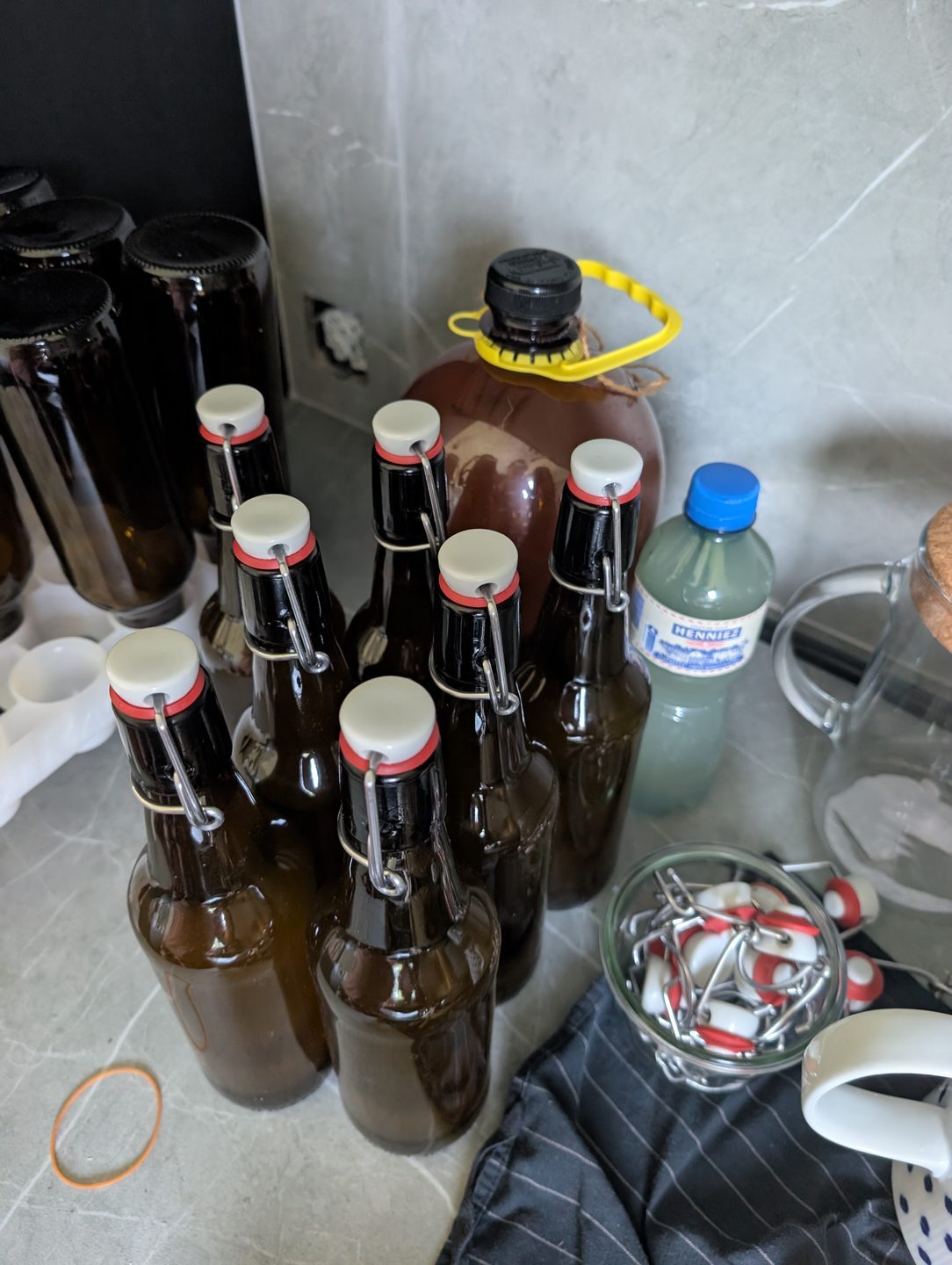
After the F1, strain, bottle in swing-top bottles (lemonade style), seal tightly, and leave 24 to 48 h at room temperature before the fridge. No F2, no bubbles.
2. Not enough sugar for the F2
Fizz is sugar turned into CO₂ by the yeasts. If all the sugar was eaten during the F1, there's none left to carbonate in F2.
At bottling, add a small sugar source: a splash of fruit juice, a few pieces of fruit, or half a teaspoon of sugar per bottle. That's the sugar that builds the pressure.
3. It's too cold
Yeasts slow down below 20 °C and nearly fall asleep around 16-18 °C. In a cool winter kitchen, the F2 can take three times as long.
Aim for 20 to 25 °C for the F2. A cupboard, the top of the fridge, a heated room: find the warmest corner of your home.
4. You're not waiting long enough
At 24 h, a cool F2 often isn't fizzy yet. The gas needs time to build under pressure.
Leave it 48 h if your room is cool, and keep an eye on it. A trick: put one plastic bottle in the batch — when it feels hard, the pressure is there and it's ready.
5. The bottle isn't airtight
A screw-cap bottle that's not fully closed, or a worn swing-top gasket, lets CO₂ leak out as it forms. The result: no pressure, ever.
Use swing-top bottles with a gasket in good shape, and check they truly seal. A thick glass lemonade bottle is made for this.
6. Tired or too few grains
Underfed grains (less than 40 g of sugar per litre in F1), stored too long in the fridge, or in too small a quantity, ferment weakly. A weak F1 makes a weak F2.
Feed your grains well, keep a decent ratio (roughly 3-4 tablespoons of grains per litre), and let them bounce back over two or three cycles if they've just come out of the fridge.
The real trap: reproducing what worked
Most of the time, the problem isn't a single cause — it's no longer knowing what you did last time. Which sugar in F2, how long, at what temperature, the time it came out perfectly fizzy? Without a record, you guess at every batch.
Watch out for the opposite too: an F2 forgotten three days in the warmth, and the bottle becomes a geyser (or shatters, in glass). Good fizz is a matter of tracked timing, not luck.
Fermenter's note. Then again, not everyone is chasing maximum fizz. Personally, I stick to the low end of the sugar range: drier, less sweet, and almost no explosion risk. Since little sugar is left for the F2, I dose it with priming sugar drops (the home-brewing kind), one per bottle — light, controlled carbonation. Barely-there bubbles don't bother me: easier on digestion, less bloating.
Track your ferments without sticky notes
If you juggle several jars, that's exactly where FermPal helps: every batch moves phase by phase (F1 → F2 → fridge), with durations and temperatures, and every recipe keeps its version history. You find again the ratio that fizzed every time, and you never leave an F2 sitting too long again.
Track my ferments with FermPal (free) →
Go further: the complete water kefir guide (grains, F1, F2) and the fermentation tracker app.